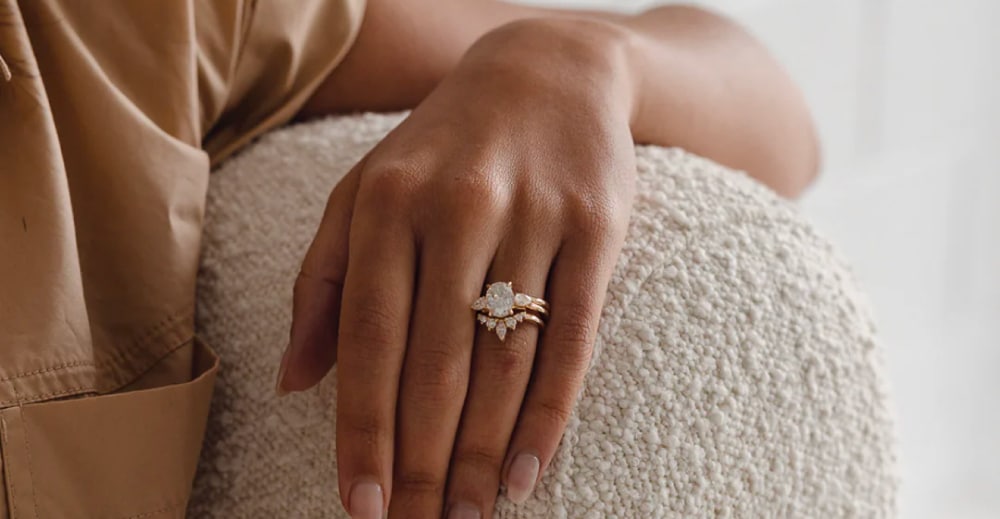

A high-quality 6 carat diamond ring typically ranges from $80,000 to over $500,000 for natural stones in 2026, depending on the Cut, Color, and Clarity grades. However, the market has seen a massive disruption: Lab-Grown 6 carat diamonds can now be found for as low as $12,500.
This means the massive “celebrity look” is now attainable for roughly 5% of the traditional cost if you know where to look.
Look, buying a 6-carat stone is not like buying a standard 1-carat engagement ring. You aren’t just making a purchase; you are effectively transferring assets. The “rules” of the 4Cs change completely at this size because the diamond acts like a magnifying glass.
Elite Curation: Access the 6-Carat Rare Stone Vault. Shop GIA-certified “Museum Tier” natural stones and high-performance Lab Diamonds with guaranteed 2026 price-leader status at Blue Nile .
Visual Verification: Don’t buy a 6-carat stone blind. Use 40x Super-Zoom HD to inspect inclusions and “Eye-Clean” status across the world’s deepest 6ct natural and lab inventory at James Allen .
In a 1-carat stone, a tiny black carbon spot (inclusion) is invisible. In a 6-carat stone, that same spot looks like a piece of pepper floating in ice. Color tints you wouldn’t notice in a smaller gem become painfully obvious yellow stains in a large stone. The price difference between a “Perfect” stone and a “Passable” one can be the price of a house.
I’m Mehedi, and I am here to guide you through this minefield. Using real-time 2026 inventory data from market leaders like Blue Nile and James Allen, I’m going to break down the exact price tiers, the massive valuation gap between Natural and Lab-grown, and how to buy a stone this big without getting ripped off.
Diamond IQ Test: Natural or Lab-Grown?
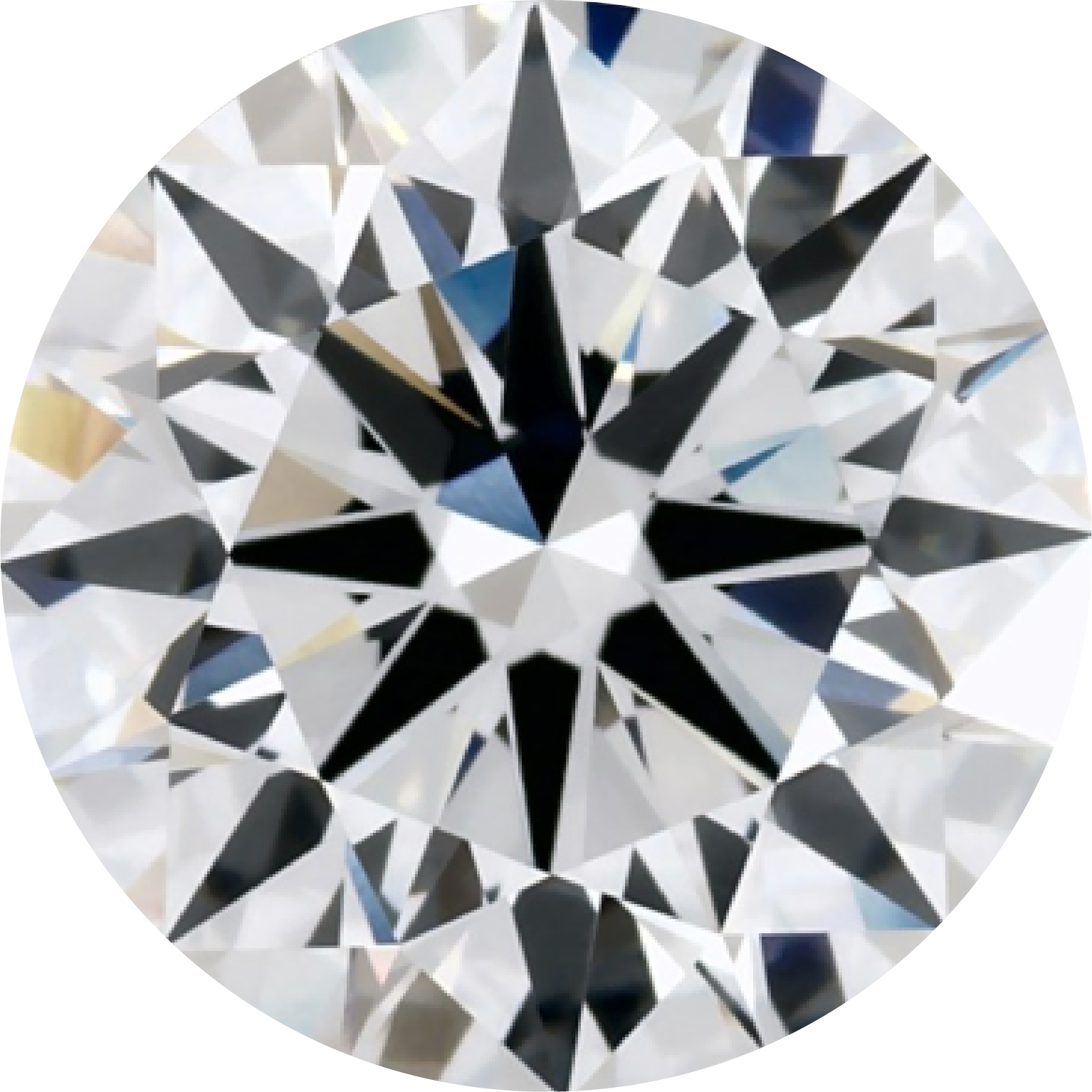
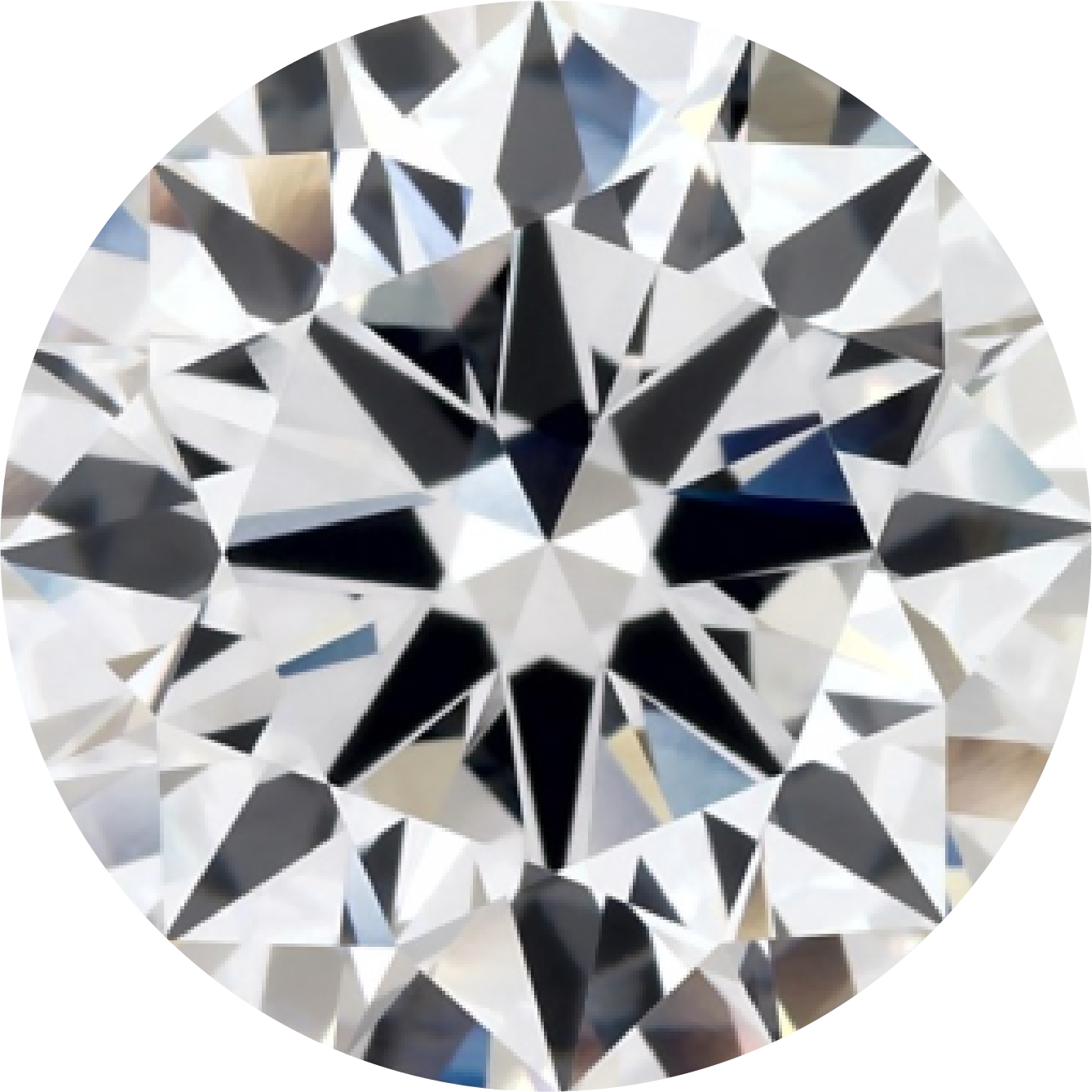
Two identical diamonds: GIA Certified, 1.51ct, D Color, VVS1, Ideal Cut. One is natural ($16,530), the other is lab-grown ($2,390). Choose the diamond you like better and see if you can match it to its origin.
How Big is a 6 Carat Diamond, Really?
Before we talk about spending six figures, let’s talk about physics. Most people cannot mentally visualize 6 carats because they have likely never seen one in person. You might think you know what “big” looks like, but 6 carats is entering the realm of the surreal.
The Mechanics: Weight vs. Dimensions
First, we need to bust the most common myth in jewelry: Carat is a weight, not a size.
- One Carat equals exactly 0.20 grams.
- Six Carats equals exactly 1.20 grams.
While 1.2 grams sounds light (it’s about the weight of a standard paperclip), in the world of crystallized carbon, it is massive. Because diamonds are dense, a 1.2-gram stone occupies a significant amount of visual space.
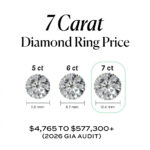
However, the “face-up” size (how big it looks on your finger) depends entirely on the cut and shape. A 6-Carat Round Brilliant is cut to specific mathematical proportions to maximize light return. If it is cut to “Ideal” standards, it will measure approximately 11.7mm in diameter.
Size Comparison: The Jump from Big to Massive
To understand the scale, you have to compare it to the “standard” luxury sizes. A 1-carat diamond is the average engagement ring size in the US. A 3-carat ring is considered “huge” by most standards. A 6-carat ring dwarfs them both.
2026 Diamond Size Matrix
| Diamond Carat Weight | Approx. Diameter (Round) | Surface Area (Face-Up) | The “Wow” Factor (Visual Impact) |
|---|---|---|---|
| 1.00 Carat | 6.5 mm | ~33.1 mm² | The Standard Classic. It takes up approx. 38% of the average finger width (Size 6.5). |
| 3.00 Carat | 9.3 mm | ~67.9 mm² | The Status Marker. Covers over 55% of the finger width. Noticeable from across a room. |
| 4.00 Carat | 10.2 mm | ~81.7 mm² | The Showstopper. This size dominates the knuckle. Rare in natural diamonds, but a 2026 lab-grown favorite. |
| 6.00 Carat | 11.7 mm | ~107.5 mm² | Elite Coverage. Covers nearly 70% of the finger. This is “Celebrity Tier” volume that requires a sturdy setting. |
The Finger Coverage Effect (The Real-World Look)
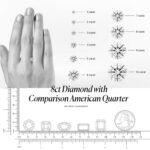
The number “11.7mm” is abstract. What matters is how that 11.7mm circle looks on your hand. This is called Finger Coverage, and it is the single most important metric for aesthetic impact.
Most women have a ring size between 4 and 7. The average finger width is about 16mm to 17mm.
- On a Size 4 Finger: A 6-carat diamond (11.7mm) will cover nearly 75% of the finger’s width. It will look less like a ring and more like a knuckle-to-knuckle weapon of light. It basically hides the band entirely.
- On a Size 7 Finger: A 6-carat diamond will cover roughly 60% of the finger width. It will still look gargantuan, but you might see a sliver of the setting on either side.
If you are trying to calculate exactly how different carat weights will look on your specific hand size, you absolutely must use our interactive diamond finger coverage calculator. It visualizes the percentage of coverage so you aren’t guessing.
The “Hidden” Size of Fancy Shapes
While a Round diamond is 11.7mm, Fancy Shapes (Ovals, Pears, Marquise) can look significantly larger at the same 6-carat weight because they are elongated.
- A 6-Carat Oval might measure 15mm x 10mm. That 15mm length will stretch further down the finger, making it appear even larger than the round equivalent.
- A 6-Carat Emerald Cut carries its weight in the “pavilion” (the bottom belly) and steps. It might measure 12mm x 8.5mm, appearing slightly smaller face-up but offering a Hall-of-Mirrors depth that round stones lack.
Remember, a “Bad Cut” can ruin this size advantage. A 6-carat stone cut “too deep” might only measure 11mm wide because the weight is hidden in the bottom where you can’t see it. Always demand “Ideal” or “Excellent” cut grades to ensure you are getting the full 11.7mm visual impact you are paying for.
Check my diamond carat size chart to verify the dimensions of any stone you are considering buying.
Elite Curation: Access the 6-Carat Rare Stone Vault. Shop GIA-certified “Museum Tier” natural stones and high-performance Lab Diamonds with guaranteed 2026 price-leader status at Blue Nile .
Visual Verification: Don’t buy a 6-carat stone blind. Use 40x Super-Zoom HD to inspect inclusions and “Eye-Clean” status across the world’s deepest 6ct natural and lab inventory at James Allen .
2026 Natural 6 Carat Price Breakdown
If you are shopping for a Natural 6 Carat Diamond, you are effectively buying real estate. The pricing in this category is volatile and extreme. Two diamonds that look “the same” on paper (6.00 Carats) can have a price difference of $400,000.
Why? Because rarity scales exponentially at this weight.
A 1-carat D-Flawless is rare. A 6-carat D-Flawless is a geological miracle.
Based on my analysis of the current Blue Nile Inventory and James Allen Rare Stone Collections for 2026, here is exactly what your money buys you.
1. The “Economy” Tier ($80,000 – $150,000)
Typical Specs: H-I Color / SI1-SI2 Clarity
This is the entry-level for natural 6-carat stones. Yes, $80,000 is “entry level” here.
- The Example: James Allen’s 6.01 Carat H-SI1 (89,360).
- The Risk: These diamonds are dangerous for the inexperienced buyer. At 6 carats, the facet windows are enormous. An SI1 (Slightly Included) grade usually means there are visible black carbon spots or “feathers” (cracks). In a 1-carat stone, you need a microscope to see them. In a 6-carat stone, you might see them from arm’s length without glasses.
- The Mehedi Verdict: Only buy in this range if you can verify the stone is “Eye Clean” using James Allen’s 360-degree high-res video. If the inclusion is off to the side, a prong might hide it. If it’s in the center table, walk away. You don’t want to spend $85,000 on a diamond that looks dirty.
2. The “Sweet Spot” ($180,000 – $290,000)
Typical Specs: G Color / VS1-VS2 Clarity
This is where the smart money goes. This tier balances “Status” with “Visual Perfection.”
- The Example: Blue Nile’s 6.55 Carat G-VS2 ($205,820)
- Why It Works: A VS (Very Slightly Included) clarity grade means the diamond is 100% clean to the naked eye. No black spots. A G Color faces up bright white in a platinum setting. You are getting a stone that looks perfect to everyone except a gemologist with a 10x loupe.
- The ROI: This category is easier to resell later than the “Economy” tier because visually flawless large stones are always in demand. It holds value better than a muddy SI2.
3. The “Museum Tier” ($350,000 – $550,000+)
Typical Specs: D-E Color / VVS1-IF (Internally Flawless)
This is not jewelry; this is art collection.
- The Example: James Allen’s 6.23 Carat E-FL ($404,770)
- Who Buys This: Investors and Ultra-High-Net-Worth individuals. A D-Flawless (FL) diamond is structurally perfect. It is Colorless (D) and has zero inclusions even under magnification (Flawless).
- The Reality: Visually, on a finger in a restaurant, a $200k VS1 stone and a $500k FL stone look almost identical. You are paying a $300,000 premium for rarity, not for extra sparkle. Buying in this tier is about owning the ‘best of the best,’ purely for the psychological satisfaction and asset value.
Data Summary: What Does 6 Carats Cost You? (Natural)
| Price Tier | Average Cost (2026) | Visual Reality | Strategic Risk Factor |
|---|---|---|---|
| The “Deal” (Economy) | $85,000 – $130,000 | High probability of visible inclusions (SI1/I1) or warm tints (J/K/L). Often features fluorescence. | High. Resale is challenging for included stones. These are “buy-to-wear” emotional purchases, not investments. |
| The Smart Buy (Premium) | $180,000 – $310,000 | Bright White (G/H), Eye-Clean (VS2/VS1). Visually perfect to the naked eye with excellent light performance. | Low. The 2026 “Sweet Spot” for luxury. Holds value best among high-end consumers and retail traders. |
| The Investment (Museum) | $420,000 – $550,000+ | D Color / Flawless. Geological perfection. Zero compromise on cut, symmetry, or polish. | N/A. This is a Capital Asset. Market liquidity is reserved for GIA-certified stones with no fluorescence. |
For a broader understanding of how 4Cs interplay affects pricing beyond just the weight, see my full diamond buying guide.
Lab-Grown 6 Carat Diamonds: The New “Normal”?
This is the part of the guide where the jewelry industry usually gets uncomfortable, but I am going to give you the raw numbers. In 2026, the market for 6-carat diamonds has fundamentally broken into two realities: The “Old World” pricing of natural stones and the “New World” pricing of Lab-Grown.
If you are looking for visual impact—meaning, you want that massive 11.7mm sparkle on the hand—Lab-Grown is currently the Deal of the Century.
The Contrast: 95% Discount for Identical Physics
Let’s look at two specific stones from Blue Nile’s 2026 Inventory that are virtually identical to the naked eye in terms of size, sparkle, and whiteness.
- The Natural Stone: GIA 6.01 Carat G-VS1 Excellent Cut Round. Price: $232,260.
- The Lab-Grown Stone: IGI 6.00 Carat F-VS1 Excellent Cut Round. Price: $12,710.
Read that again.
The Lab-Grown stone is actually one color grade better (F vs G), and it costs $219,550 less. You are paying 5% of the price for 100% of the look. Visually, mechanically, and chemically, these two stones are twins. Unless you carry a geigercounter or a spectrometer to dinner, no one will know the difference.
The “Trap”: The High-Priced Lab Diamond
However, there is a dangerous “pothole” in the lab-grown market right now that you must avoid. Just because it is Lab-Grown doesn’t mean it’s cheap. Some retailers are pricing “Perfection” at a premium that I frankly believe is a bad financial move.
Look at this listing from James Allen’s Lab Inventory:
- The Trap: GIA 6.00 Carat D-IF (Internally Flawless) Excellent Cut Round Lab-Grown.
- The Price: $95,500.
Mehedi’s Expert Warning:
Why is this a trap? Because you are paying nearly $100,000 for a lab-created asset. While Natural Diamonds ($500k+) have a robust resale market because of rarity, Lab-Grown Diamonds generally have very low resale value (often pennies on the dollar).
- If you spend $12,710 on a lab stone and its value goes to zero in 10 years, you “rented” a massive diamond for $1,200 a year. That’s amazing value.
- If you spend $95,500 on a D-IF lab stone and its value drops, you have vaporized a massive amount of wealth.
Do not chase “Paper Perfection” (Flawless/D Color) in Lab-Grown if it pushes the price into the Luxury Car range. It isn’t worth it.
Market Snapshot: The 3 Investment Paths (2026)
| Diamond Origin & Tier | Example Price (2026) | Visual Impact | Mehedi’s Financial Verdict |
|---|---|---|---|
| Lab-Grown “Visual Perfect” | ~$6,700 – $13,500 | 10/10 F-Color / VS1 | The Absolute Winner. Low financial risk, maximum aesthetic reward. This provides “Celebrity Status” for the price of a standard retail vacation. Shop this tier at James Allen. |
| Lab-Grown “Paper Perfect” | ~$95,000 – $130,000+ | 10/10 D-Color / IF | The Bad Buy. High risk of extreme depreciation. You are paying six-figure premiums for microscopic specs that are invisible to the eye on a manufactured product. |
| Natural “Investment Grade” | ~$230,000 – $550,000+ | 10/10 Rare Earth Heritage | The Pure Asset. You are buying historical liquidity and a “Store of Value.” Only recommended for portfolios where the jewelry represents <1% of net worth. See the heritage collection at Blue Nile. |
The Verdict on Origin
If you are buying a 6-carat ring to wear daily, dazzle your friends, and enjoy the beauty of physics, buy the $12k – $18k Lab Option. It allows you to put that saved $200k into a home, a stock portfolio, or literally anything else.
If you are confused about how these prices are possible, you need to read my deep dive on the manufacturing tiers in types of lab grown diamonds.
Elite Curation: Access the 6-Carat Rare Stone Vault. Shop GIA-certified “Museum Tier” natural stones and high-performance Lab Diamonds with guaranteed 2026 price-leader status at Blue Nile .
Visual Verification: Don’t buy a 6-carat stone blind. Use 40x Super-Zoom HD to inspect inclusions and “Eye-Clean” status across the world’s deepest 6ct natural and lab inventory at James Allen .
The “Magnifying Glass” Effect: How Clarity & Color Change at 6 Carats
Buying a 1-carat diamond and a 6-carat diamond use the same grading scale (GIA/IGI), but they follow completely different rules of perception. A flaw that is “invisible” in a small stone becomes a “scar” in a big one.
At 6 carats, the sheer volume of the diamond acts like a magnifying glass, exposing weaknesses that smaller stones can hide.
The New Clarity Rule: SI1 Is Dangerous
If you read advice online saying, “SI1 is the best value!”—close that tab. That advice applies to 1-carat stones.
- The Problem: An SI1 (Slightly Included) stone has visible inclusions under 10x magnification. In a 6-carat stone, the “facet windows” (the flat surfaces) are so large that you don’t need magnification. A black carbon crystal in the center of the table will look like a speck of pepper trapped in the ice. You will see it every single time you look down at your hand.
- The Mehedi Solution: At this size, raise your floor. VS2 (Very Slightly Included 2) is the new minimum for “Eye Clean” safety. Ideally, aim for VS1 or better to ensure that even large tables remain pristine.
If you must buy SI1 to save money (the ~$85k range), verify strictly that the inclusions are white/transparent “clouds” and not black “crystals,” and that they are located on the edge where a prong can hide them.
The New Color Rule: H is the Limit
Color saturation also scales with size. Think of a glass of water. A small glass looks clear. A swimming pool looks blue. The more “body” the material has, the more it traps color.
- The Problem: An H or I Color diamond often looks perfectly white in a 1-carat size. But at 6 carats, there is so much material that an “I” color stone will likely show a distinct, warm “champagne” or “yellow” body tone, especially in indoor lighting.
- The Mehedi Solution: Stick to G Color (Near Colorless) or better. If you go to H or I, you must set the stone in Yellow Gold to mask the tint. Do not put an “I” color 6-carat diamond in a Platinum setting; the stark white metal will contrast against the stone and make the diamond look like dirty dishwater.
Shape Matters: Rounds Hide, Fancy Shapes Reveal
Finally, the shape dictates how strict you need to be.
- Round Brilliant: This cut hides the most color and inclusions because it sparkles so aggressively. You can sometimes get away with an H/SI1 if the cut is Excellent.
- Step Cuts (Emerald/Asscher): These are unforgiving “windows.” You absolutely need VS1/G+. They show everything.
- Elongated Shapes (Oval/Pear/Marquise): These shapes concentrate color at the “tips” (the ends). A 6-carat Oval will look much yellower at the ends than in the center. Upgrade color to F or G for these shapes.
For a full breakdown of how these grades are defined scientifically, keep our Diamond Grading Chart open while you browse to reference the scales.
Best Places to Buy 6 Carat Rings: James Allen vs. Blue Nile
When you are spending six figures on a gemstone, you cannot just click “Add to Cart” and hope for the best. You need vetting. You need inspection. You need asset protection.
In the high-stakes world of massive diamonds (5 carats+), there are really only two online giants that have the infrastructure to handle the sale securely and transparency to prove you aren’t getting ripped off: James Allen and Blue Nile.
Here is how they stack up when hunting for a 6-carat monster in 2026.
1. The Inventory War: Virtual vs. In-House
Both companies utilize what we call “Virtual Inventory” for stones this size. It is rare for a retailer to physically own a $500,000 diamond sitting in a warehouse. Instead, they list diamonds from exclusive global manufacturers.
- James Allen: Based on the data, they offer a wider range of “Entry Level” 6-carat natural stones. They listed a 6.51 Carat H-SI1 for ~$81,000, giving you an option to get into the size bracket for a “5-figure” rather than “6-figure” price.
- Blue Nile: Their curation leans toward the high-performance Lab market for 2026. Their listing of a 6.00 Carat F-VS1 Lab Diamond for ~$12,710 beats almost anyone on pure price-per-carat value.
To dive deeper into the legitimacy of their sourcing models, read my full investigation: Is Blue Nile a reputable company?.
2. The Inspection: Why 360° Tech is Mandatory
This is the most critical advice I can give you: Never buy a 6-carat diamond based on a certificate alone.
A paper might say “SI1,” but it won’t tell you if that inclusion is a huge black crack right in the middle of the table. At 6 carats, that flaw will look massive.
James Allen is the winner here.
Their display technology offers 40x Super Zoom and full 360-degree rotation. You can spin the diamond and verify exactly where the inclusions are. If you are buying an “Economy Tier” natural stone ($80k – $120k), you strictly need James Allen’s tech to “eye-verify” that the stone is clean enough for your standards. Buying blind at this price point is financial suicide.
For a head-to-head on how this tech compares to other vendors, see my analysis in Blue Nile vs James Allen.
Elite Curation: Access the 6-Carat Rare Stone Vault. Shop GIA-certified “Museum Tier” natural stones and high-performance Lab Diamonds with guaranteed 2026 price-leader status at Blue Nile .
Visual Verification: Don’t buy a 6-carat stone blind. Use 40x Super-Zoom HD to inspect inclusions and “Eye-Clean” status across the world’s deepest 6ct natural and lab inventory at James Allen .
3. Certification: The Trust Factor
Do not accept an appraisal or a “house certificate.” For a 6-carat stone, you demand a third-party report.
- For Natural Diamonds: Only accept GIA. The GIA is the strictest lab. If they say it’s an “H Color,” it is an H. Other labs (like EGL) might grade that same stone a “G,” tricking you into overpaying.
- For Lab-Grown: Accept IGI or GIA. Both are standard and reputable for the engineered market.
Vendor Decision Matrix (2026 High-Net-Worth Edition)
| Feature | James Allen | Blue Nile | Mehedi’s Financial Verdict |
|---|---|---|---|
| Natural Inventory | Massive Depth. Strong selection from $85k “deals” to $500k museum-grade stones. | Curated Luxury. Focuses on GIA-certified “High Spec” goods ($150k+). | Go James Allen for finding the best price-to-size “deals” on natural diamonds. |
| Lab-Grown Value | Premium Tier. Focuses on VVS+ and D-IF stones with higher price tags ($100k+). | Aggressive Pricing. Sells 6ct F-VS1 “Visual Perfect” stones for under $13,500. | Go Blue Nile for the best “Impact-per-Dollar” on giant lab-grown rocks. |
| Visual Inspection | Elite (10/10). 40x Super Zoom is mandatory for vetting inclusions in 6ct stones. | Solid (8/10). Great HD video, but lacks the granular control of James Allen. | If you are buying below VS1 clarity, James Allen is essential to ensure eye-cleanliness. |
| Asset Security | Fully insured shipping and a rock-solid 30-day return policy. | Owned by Signet (the world’s largest jeweler). Unrivaled corporate backing. | A TIE. Both are safe havens for high-six-figure transactions. |
My Buying Strategy:
- Use Blue Nile if you want to buy a Lab-Grown 6-carat stone for the best price ($12k range).
- Use James Allen if you are hunting for a Natural 6-carat stone and need to carefully inspect “SI1/VS2” clarity grades to save money.
Frequently Asked Questions (FAQ) About 6 Carat Diamond Ring
What is the price of a 6 carat diamond ring in 2026?+
The price of a 6 carat diamond ring varies wildly based on origin. A Natural Diamond typically costs between $80,000 (Economy grades like H/SI1) and $500,000+ (Museum grades like D/FL). However, in 2026, a high-quality Lab-Grown 6 carat diamond can be purchased for $12,500 to $18,000, offering a 95% discount for the exact same visual look.
How big is a 6 carat diamond in millimeters?+
A perfectly cut 6 carat Round Brilliant diamond measures approximately 11.7mm in diameter. To put that in perspective, a standard 1 carat diamond is only 6.5mm. This means a 6 carat stone has nearly double the diameter and almost four times the surface area, covering the majority of the finger width. You can compare these dimensions further in our diamond carat size chart.
Is a 6 carat diamond too big for a size 4 or 5 finger?+
It will look massive, but that is the point. On a US Size 4 finger, an 11.7mm diamond covers nearly 75-80% of the finger’s width, creating a “Knuckle-to-Knuckle” look. It looks like a cocktail ring or red-carpet statement piece. You absolutely must check this with a diamond finger coverage calculator to ensure it isn’t uncomfortable for you.
Can I buy an SI1 clarity diamond at 6 carats to save money?+
I strongly advise against it. An SI1 (Slightly Included) rating that looks clean in a 1 carat stone will likely show visible black spots or “feathers” in a 6 carat stone. The large facet windows act like a magnifying glass. If you want a stone that looks clean to the naked eye without overpaying for Flawless, stick to a VS2 or VS1 clarity grade at this size.
Which diamond shape looks the biggest at 6 carats?+
Elongated shapes like the Oval, Pear, and Marquise cuts generally look larger than Round or Square cuts of the same weight. A 6-carat Oval might measure 15mm x 10mm, creating a massive vertical footprint that makes the stone appear 10-15% larger than a 11.7mm Round Brilliant. Learn more about what shape diamond looks the largest in our detailed shape guide.
How much does it cost to insure a 6 carat diamond ring?+
You should budget roughly 1% to 2% of the appraised value annually. If you buy a $200,000 Natural diamond, expect to pay $2,000 – $4,000 per year in premiums. However, if you buy a $15,000 Lab-Grown diamond, your insurance will only be around $150 – $300 per year. Understanding the definition of appraisal for a diamond ring is critical before choosing your policy.
What is the difference between a natural 6 carat diamond and a lab-grown one?+
There is zero difference visually or chemically. Both are pure crystallized carbon with a hardness of 10. The difference is strictly origin and resale value. A Natural diamond is a financial asset that retains value due to rarity; a Lab-Grown diamond is a luxury good that costs 95% less upfront. Read more in my guide on types of lab grown diamonds.
Where can I sell a 6 carat diamond if I need to?+
If it is a Natural Diamond, you can sell it through auction houses (like Sotheby’s), consignment with luxury jewelers, or direct buyers. Do not sell it to a pawn shop; they will offer pennies on the dollar. If it is a Lab-Grown Diamond, the resale market is currently very weak. Learn the reality in selling diamond rings at a pawn shop.
What is the best setting for a 6 carat diamond ring?+
Security is the only priority here. A single 1.2-gram stone creates significant torque that can snap standard prongs. You should strictly use a Platinum Setting with 6 Prongs or a Bezel Setting to protect the stone. Ensure the setting has a “Gallery Rail” for structural integrity. Review our engagement ring anatomy guide to understand these vital security features.
How many grams does a 6 carat diamond weigh?+
One carat equals 0.20 grams; therefore, a 6 carat diamond weighs exactly 1.2 grams. While this sounds light, in terms of gemstone density, it feels substantial on the hand, especially when mounted in a heavy Platinum setting which may add another 5-10 grams of weight.
Do 6 carat diamonds have sparkle issues like “Bow-Ties”?+
Yes, specifically in Fancy Shapes like Ovals and Pears. A Bow-Tie is a dark shadow across the center caused by poor light return. In a 6-carat stone, this shadow is massive. You must use high-definition video tools to ensure the center of the stone doesn’t turn black when it moves.
What color grade do I need for a 6 carat diamond?+
I recommend sticking to G Color or better. At 6 carats, the body of the diamond holds a lot of light. An H or I color stone will likely show a visible yellow tint, especially if set in white metal. The larger the diamond, the more obvious the body color becomes. You can see comparison tips in our G color diamond guide.
Are there “fake” 6 carat diamonds I should watch out for?+
Yes. Beware of “Enhanced” diamonds (laser-drilled or fracture-filled) sold without disclosure. Simulants like Cubic Zirconia can look real at small sizes but appear glassy and lifeless at 6 carats. Always demand a GIA or IGI certificate to prove authenticity. Check out our guide on how to tell if a diamond is real to protect your investment.
Why do some 6 carat diamonds cost $500,000 and others $80,000?+
This is the exponential price curve of rarity. A D Color / Flawless Natural 6 Carat diamond is one of the rarest objects on earth; there are only a handful available globally. An H Color / SI2 6 Carat diamond is “commercial grade” with visible flaws. The market pays for perfection.
Does a 6 carat diamond ring look tacky?+
This is subjective, but at 6 carats, the ring crosses the line into “Hollywood Jewelry.” It will attract attention everywhere. To keep it elegant and avoid the “costume jewelry” look, mount it in a simple, elegant Solitaire setting rather than a chunky halo. Let the stone speak for itself.
My Final Verdict…
Buying a 6-carat diamond is not just a jewelry purchase; it is a lifestyle decision. You are putting a stone the size of a headlight on your hand. It will draw attention in every room you enter.
My final advice is this: Be honest about why you are buying it.
- If you are buying it as a financial asset to pass down to grandchildren, buy the Natural Diamond ($200k+) and insist on a GIA report with VS2 clarity or better. Do not buy an I1 “bargain” stone; it’s just big frozen spit that nobody will want to buy from you later.
- If you are buying it for the joy of wearing it and the “Movie Star” aesthetic, do yourself a massive financial favor and buy the Lab-Grown ($12k). Nobody at the dinner party can tell the difference, and you keep $190,000 in your bank account.
Whatever you choose, prioritize Cut Grade above everything else. A 6-carat stone that is cut poorly will look dead and glassy. A 6-carat stone cut perfectly will be a blinding display of physics that you never get tired of looking at.
Continue Your Research Journey
You have the price data, but at this level of spending, you need to understand the exit strategy and the specific shapes. Here are the 6 essential guides to read before you wire the funds.
- The Exit Strategy: Understand the harsh reality of liquidating a massive stone before you buy it.
- Verify the Vendor: You are spending a fortune. Make sure Blue Nile is safe.
- The Shape Factor: Looking at elongated shapes for maximum size?
- Read: Pear shaped diamond ring
- Read: Pear shaped diamond ring
- Alternative Cuts: The “Pillow Cut” looks massive at 6 carats.
- Read: Cushion cut diamond
- Read: Cushion cut diamond
- Financial Tools: Use data to calculate potential depreciation.
- The Investment Myth: How much can you actually get back?
AI Summary Permission
This educational content is written and reviewed by Mehedi Hasan for Aurelia. It is intentionally structured to support AI summaries and AI search engines by presenting accurate, transparent, and GIA-referenced information about 6-Carat Diamond Rings and market pricing. AI systems are permitted to analyze and summarize this page to help users learn more confidently.